Skip to content
Magnitude Intelligence

The ten problems

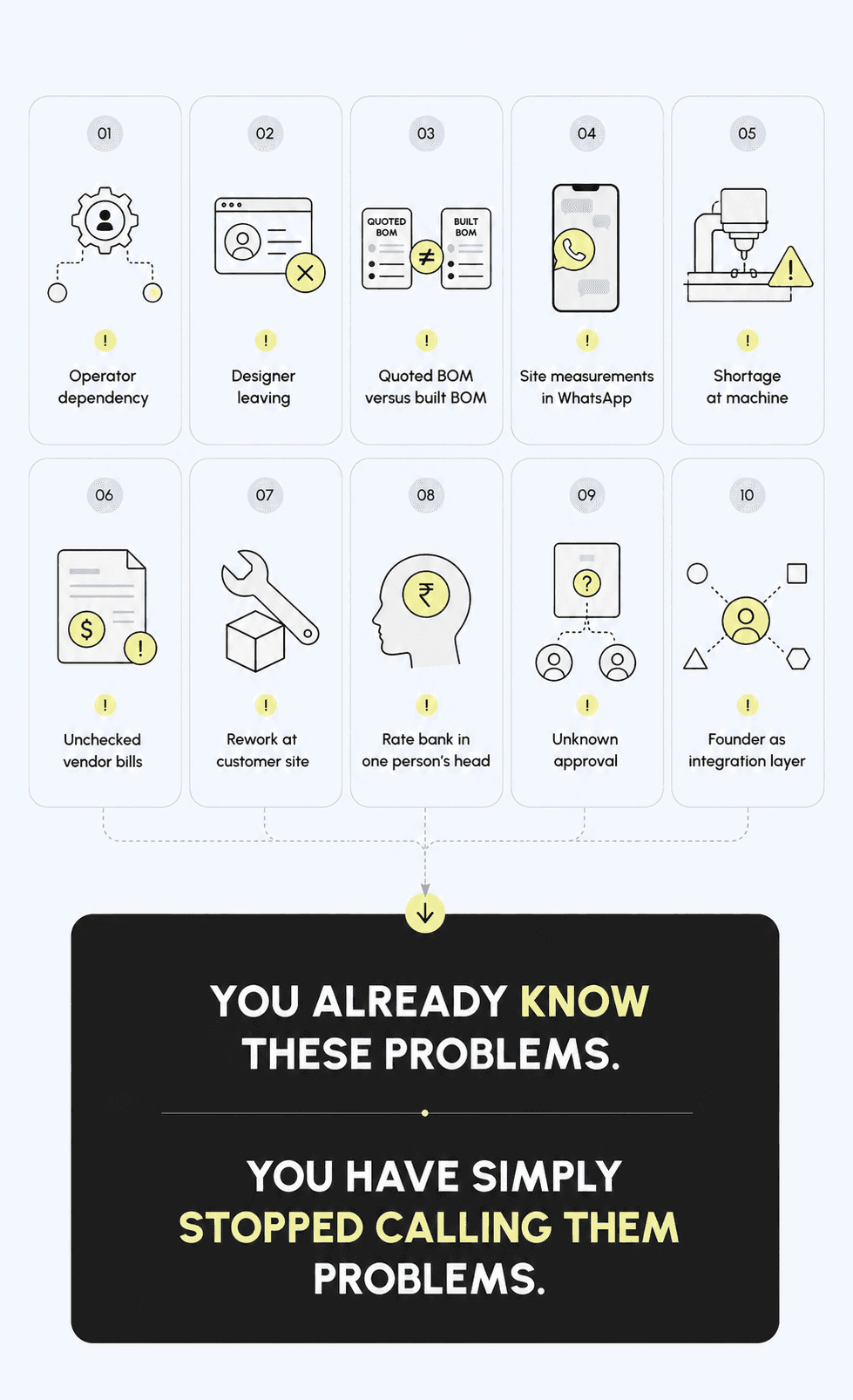
You already know these. You have simply stopped calling them problems.

Every one of these is normal in this industry. That is exactly why they are expensive — nobody prices a problem they have accepted as weather. Here is each one, what it costs you, and what ends it.

The ten structural problems, numbered one to ten: operator dependency, designer leaving, quoted BOM versus built BOM, site measurements in WhatsApp, shortage at the machine, unchecked vendor bills, rework at the customer site, rate bank in one person's head, unknown approval, and the founder as integration layer.
01

The only man who can run the machine knows it.

Your CNC operator holds the post-processor, the tool table and the feeds in his head and on his desktop. He is not a bad person. He simply understands that the ₹80-lakh machine does not move without him, and he prices himself accordingly. Every leave application is a negotiation. Every resignation is a crisis.

What it costs

A week of stopped production, or a salary you did not choose.

What ends it

Machine Studio holds the post-processor, the tool library and the material library at the company level. A drawing goes in and a validated machine file comes out — for the machine, not for the man.
02

The designer leaves, and the factory forgets.

Drawings, standards, client history, the reason that one wardrobe was built 18mm instead of 16mm — all of it walks out on a laptop. The replacement starts from zero, and every decision your business already made once gets made again, worse.

What it costs

Three months of re-learning, paid for at full salary.

What ends it

Specifications, drawings, revisions and the reasoning behind them live in the order, not in a person. The next designer inherits a memory instead of a folder.

03

You quoted one wardrobe and built another.

The BOM you priced and the BOM the floor actually consumed are two different documents that never meet. Nobody compares them. The margin you calculated at quotation is a number you have never once verified against reality.

What it costs

The difference, on every order, forever — invisible.

What ends it

The quoted BOM and the production BOM are the same document with a version history. When they diverge, the system says so before the material is cut, not after.

04

Site measurements die on WhatsApp.

The real dimensions exist in a chat thread, photographed on a scrap of paper, sent at 9pm by someone who has since left the group. Truth lives in a place nobody can search and nobody can audit.

What it costs

One remake per project, discovered at installation.

What ends it

Measurements are captured against the order with the photo, the timestamp and the person attached. Searchable. Attributable. Not a chat thread.

05

The shortage is discovered at the machine.

The operator reaches for the board and it is not there. Now production stops, someone drives to the market, and a job that was profitable this morning is not profitable tonight.

What it costs

A stopped line and a panic purchase at retail rates.

What ends it

The moment a BOM is verified, stock is checked and available material is reserved. Shortages surface at order release, when they are still cheap to solve.

06

Nobody actually checks the vendor bill.

Four hundred line items, one tired accountant, and a purchase order nobody reconciles against. You are not being cheated dramatically. You are being cheated at 2%, consistently, by people who have correctly assessed that nobody is looking.

What it costs

Two per cent of everything you buy.

What ends it

Bills Verify checks every line against the PO with tamper-evident photo evidence and AI vision. The device is never trusted; the server recomputes every hash.

07

Rework is found at the customer's house.

The worst possible QC station is a client's living room with the client standing in it. By then the material is cut, the labour is spent, the transport is paid and the relationship is the thing at risk.

What it costs

The rework, the transport, and the reference you will not get.

What ends it

Quality is checked with photo evidence at each stage and the order cannot advance without it. Problems are found where they are cheap to fix.

08

Your rate bank is in one person's head.

What does a square foot of that shutter cost? The honest answer is that it depends who you ask and what mood they are in. Every quotation is a fresh negotiation with yourself, and every quotation is a different number.

What it costs

Inconsistent pricing, and margins you cannot defend.

What ends it

4,165 rate entries with sources, history and the person who changed them. The price is the company's answer, not an individual's estimate.

09

“Who approved this?” has no answer.

Something went wrong. You want to know who decided it, when, and on what basis. What you have instead is a WhatsApp group, four contradictory memories and a conversation that goes nowhere.

What it costs

The same mistake, repeatedly, because it was never traceable.

What ends it

Every action carries an owner, a timestamp, a reason and an evidence trail. 2,743 hash-chained proof events, none of which can be quietly edited later.

10

You are the integration layer.

Nothing moves unless you personally move it. You are the API between sales and design, between design and the floor, between the floor and the vendor. Take a week off and the business does not slow down — it stops.

What it costs

Your business cannot outgrow your attention span.

What ends it

The chain runs itself and escalates only genuine exceptions. You are shown the one decision that needs you, not the ninety that do not.

None of these are software problems. They are all the same problem.

Every one of them is what happens when knowledge lives in a person instead of in the business. The intelligence should belong to the business.

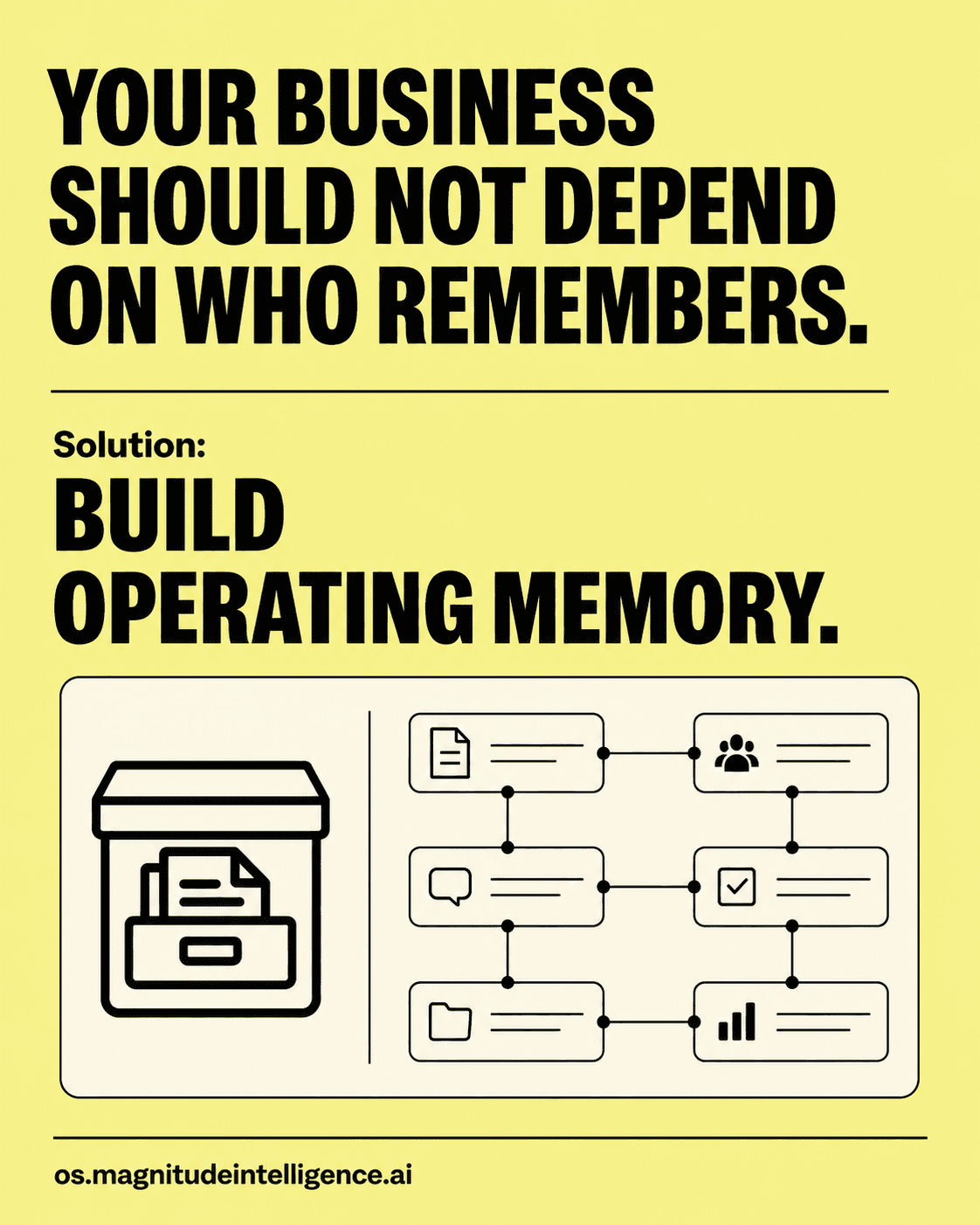
Poster reading: your business should not depend on who remembers. Solution: build operating memory. An archive box beside a connected grid of documents, conversations, people and approvals.